
Use It or Lose It: The Case for Staying Active as You Age
Let’s be honest — most of us know we should be moving more. We’ve heard it from our doctors, seen it in the headlines, told ourselves we’d get back to it after things settle down. But here’s the thing: for older adults, “getting back to it later” carries real consequences that most people don’t fully appreciate until something goes wrong.
There’s a reason physical therapists and geriatricians keep coming back to the same phrase: use it or lose it. It’s not a lecture. It’s just biology. The body responds to what you ask of it — and when you stop asking, it quietly starts letting go of what it no longer needs.
The good news? It responds to effort at any age. It’s never too late. But the window to act is always now.
What Sitting Is Actually Doing to You
We’ve all heard that smoking is bad. What fewer people realize is that prolonged sitting has been compared — seriously, in peer-reviewed research — to smoking in terms of its health impact. That’s not hyperbole. That’s where the science has landed.
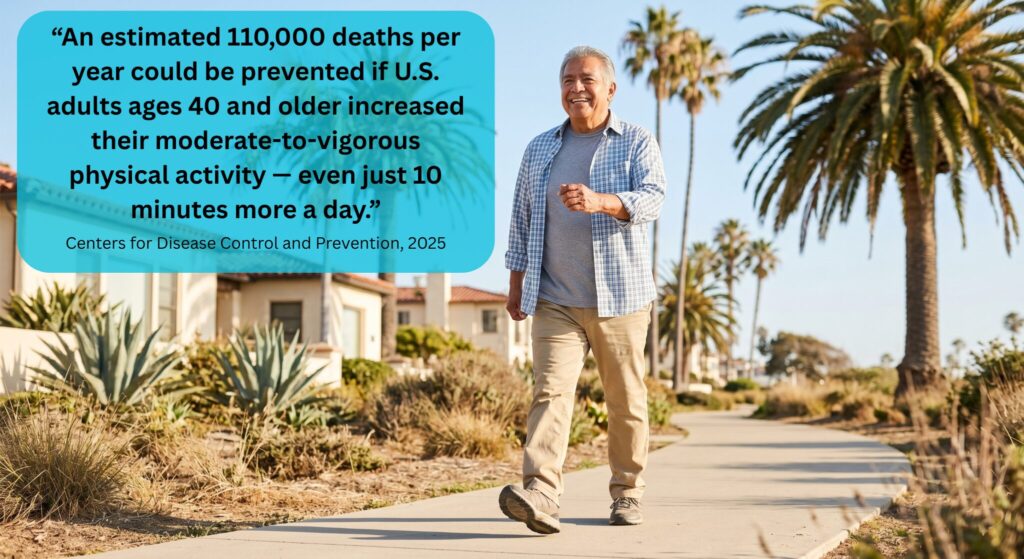
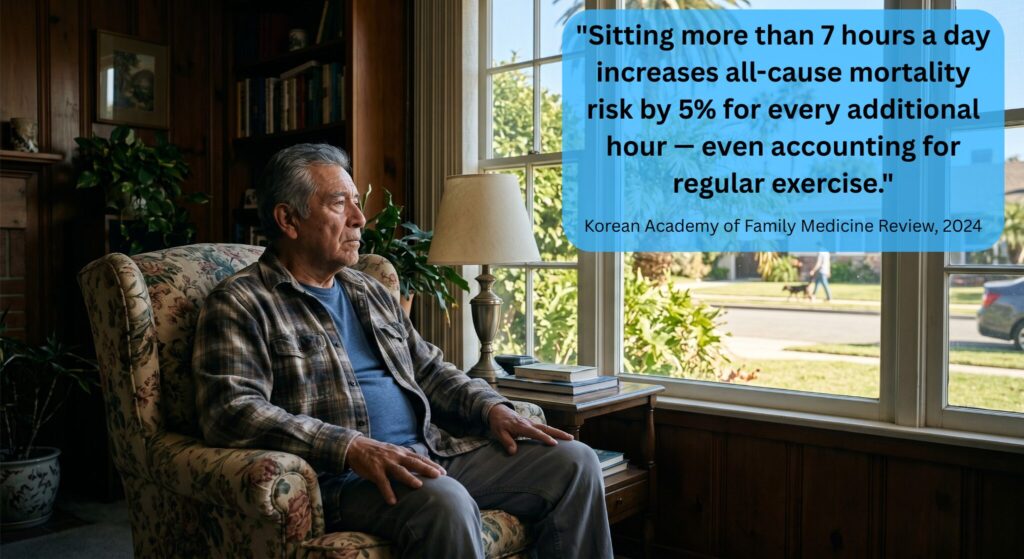
Research shows that sitting more than 7 hours a day increases all-cause mortality by 5% for every additional hour — even in people who exercise regularly. So if you’re hitting the gym three days a week but spending the rest of your time in a chair, you’re only partially offsetting the damage. Movement throughout the entire day matters, not just during designated workout windows.
A 2024 study in JAMA Network Open found that people who sat for extended periods faced a 34% higher risk of death from cardiovascular disease. And perhaps most alarming — a 2025 study in Alzheimer’s & Dementia found that sedentary behavior was an independent risk factor for Alzheimer’s disease. More sedentary participants showed greater cognitive decline even when they met the standard exercise recommendations.
This isn’t meant to alarm — it’s meant to motivate. Because the flip side of all this research is equally clear: movement works. Consistently. Measurably. At every age.
The Quiet Crisis of Muscle Loss
Here’s something that doesn’t get talked about nearly enough: starting around age 30, we all begin losing muscle mass. Not dramatically at first — maybe 3% to 5% per decade. But by the time most people reach their 70s and 80s, they’ve lost roughly 30% of the muscle they once had. That loss has a name — sarcopenia — and an estimated 25% to 45% of U.S. seniors are living with it right now, most without knowing it.
What does that actually look like in real life? It looks like having trouble getting up from a chair. It looks like feeling unsteady on stairs. It looks like a fall that didn’t used to be possible, a fracture that takes months to recover from, and a slow narrowing of the world that was once wide open.
The remarkable thing is that this doesn’t have to be the story. Muscle responds to resistance training at 70, 80, even 90. The body still adapts. It still builds. It just needs to be asked.
Starting Where You Are
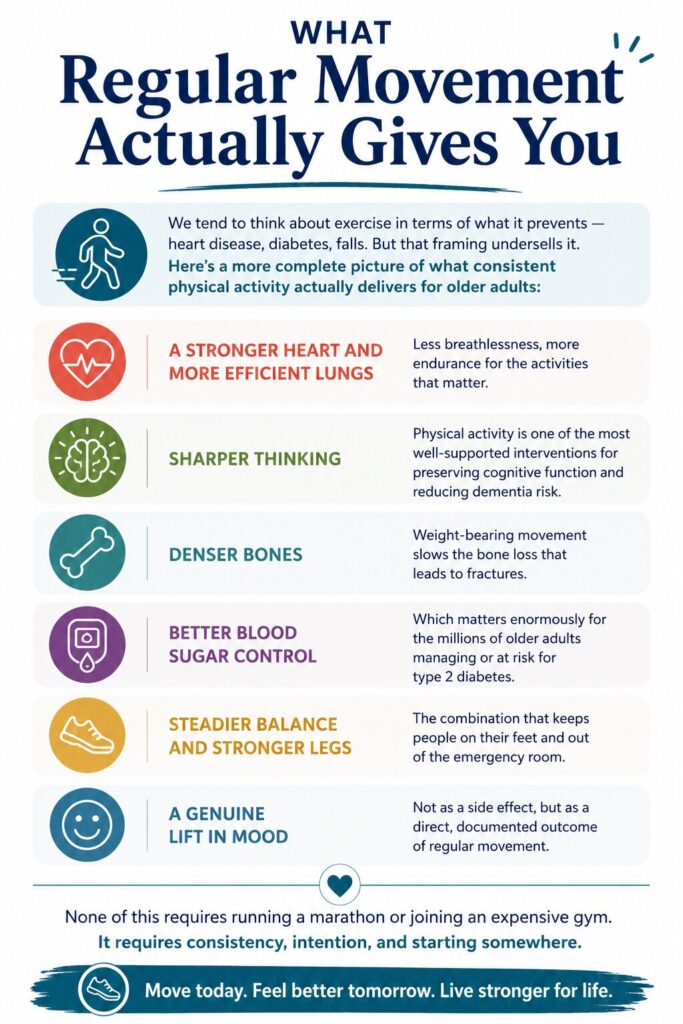
If you’ve been sedentary for a while — or if you’re supporting a loved one who has — the starting point matters less than simply having one. A 10-minute walk is not a consolation prize. It’s a legitimate physiological stimulus. It counts.
A few practical principles worth keeping in mind:
Build a routine that includes all three components — aerobic activity (walking, swimming, cycling, dancing), strength training (resistance bands, light weights, bodyweight exercises), and balance work (tai chi, yoga, simple one-leg standing). You don’t need to do all three every day. You need to do them consistently over time.
If you don’t like exercising alone — and many people don’t — find a class, a walking partner, or a group. San Diego County senior centers, YMCAs, and Parks and Recreation programs offer senior-specific fitness options, many of them free or low cost. Consistency is dramatically higher when someone else is expecting you to show up.
And if mobility limitations make traditional exercise feel out of reach, chair-based exercises are real exercise. Water-based movement is real exercise. A slow walk around the block is real exercise. Meet yourself where you are.
You Can’t Out-Exercise a Poor Diet
Here’s where a lot of conversations about senior fitness fall short — they focus entirely on movement and skip the other half of the equation entirely. Nutrition and physical activity are inseparable. One without the other produces incomplete results.

Muscle is built from protein. When the body doesn’t have enough of it, resistance training produces far less benefit — there’s simply nothing to build with. Research shows that older adults need significantly more dietary protein than younger adults — up to 1.2 to 1.5 grams per kilogram of body weight per day — just to keep pace with age-related muscle loss. Most seniors aren’t close to that number.
Beyond protein, staying active requires energy — which comes from consistent, balanced meals that include the right carbohydrates, healthy fats, calcium, vitamin D, and a range of micronutrients that support bone, heart, and brain health.
The problem is that for many older adults, eating well is harder than it sounds. Cooking becomes difficult when arthritis flares up, when fatigue sets in, or when the motivation to cook for one just isn’t there. Grocery shopping becomes a barrier when driving isn’t safe and transportation is unreliable. Bit by bit, meals get simpler. Smaller. Less nutritious. And the physical consequences follow — less energy, less strength, less capacity to do the very activities that would help.
This is precisely where home-delivered meal programs make a difference that goes far beyond what most people expect. According to the 2024 National Survey of OAA Participants, 85% of home-delivered meal recipients said they eat healthier because of the program — and 93% said it helped them live more independently. A 2025 study published in JAMA Network Open, conducted with Brown University and Johns Hopkins, found that home-delivered meals improved physical and emotional wellbeing and directly supported independence.
For Meals on Wheels San Diego County, every meal that goes out the door is designed to meet the specific nutritional needs of older adults — the protein, the calories, the balance that supports an active, healthy life. For a senior who might otherwise skip dinner or reach for something that doesn’t serve them, that delivery isn’t just a meal. It’s the fuel that makes everything else possible.
San Diego Makes This Easier Than Almost Anywhere Else
Here’s something worth saying out loud: we live in one of the best places in the world to stay active as we age. And that’s not just civic pride talking — it’s a genuine advantage that San Diego seniors have over most of the country, and one that’s worth taking seriously.
Over 266 sunny days a year. Mild temperatures every month. The kind of weather that, for the rest of the country, is a seasonal luxury — and for us, is just a Tuesday in January.
That matters because weather is one of the most commonly cited barriers to regular physical activity. Here, that barrier is almost entirely removed.
And the options are remarkable:
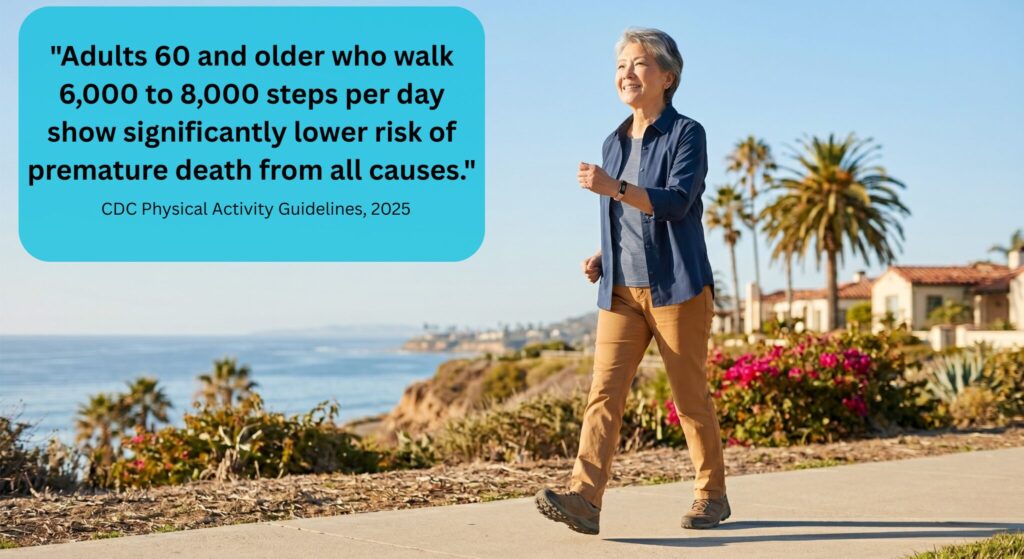
The coastline alone — from Coronado to Ocean Beach to Pacific Beach to La Jolla — offers miles of flat, accessible, beautiful walking terrain. Sand walking adds natural resistance. The ocean provides a built-in destination. It never gets old.
Balboa Park is a world-class outdoor resource sitting in the middle of the city — accessible paths, botanical gardens, museums, and fresh air, all within reach of a short drive or bus ride. Tecolote Canyon, Los Peñasquitos Canyon, and the Lake Murray trail offer quieter, shaded walks through some of the county’s most beautiful natural spaces.
The city and county offer senior-specific outdoor fitness programs — yoga in the park, tai chi classes, walking clubs — many of them free. Farmers markets, outdoor concerts, and neighborhood events create natural opportunities for movement that don’t feel like exercise at all.
For seniors who are homebound or managing limitations, even a few minutes in the backyard or on the front porch counts. Sunshine. Fresh air. A short walk to the corner. San Diego makes it easy to find a reason to step outside — and stepping outside is where it starts.
For clients who receive meals from Meals on Wheels San Diego County, that daily visit from a volunteer is often exactly that kind of nudge. A moment of connection. A reminder that the world is still out there, that the city is still alive, and that someone cares whether you’re part of it.
The Bottom Line
The research is clear, but it really comes down to something simpler: the more you move, the more you can move. The more you nourish your body, the more it has to give. And in a city like San Diego — with its trails, its coastline, its weather, and its community — the conditions for healthy, active aging are about as good as they get.
Start where you are. Ask your doctor. Connect with a local senior center or fitness program. And if consistent, nutritious meals are a missing piece of the puzzle, Meals on Wheels San Diego County is here to help fill that gap — one delivery at a time.